A good moisturizer should do more than just sit on top of your skin.
I talk a lot about thoughtfully formulated skincare, but what does that actually mean?
Take a moisturizer. It isn’t about finding one magical ingredient. It’s about putting ingredients together that do different jobs—and getting the balance right.
So, how does moisturizer work?
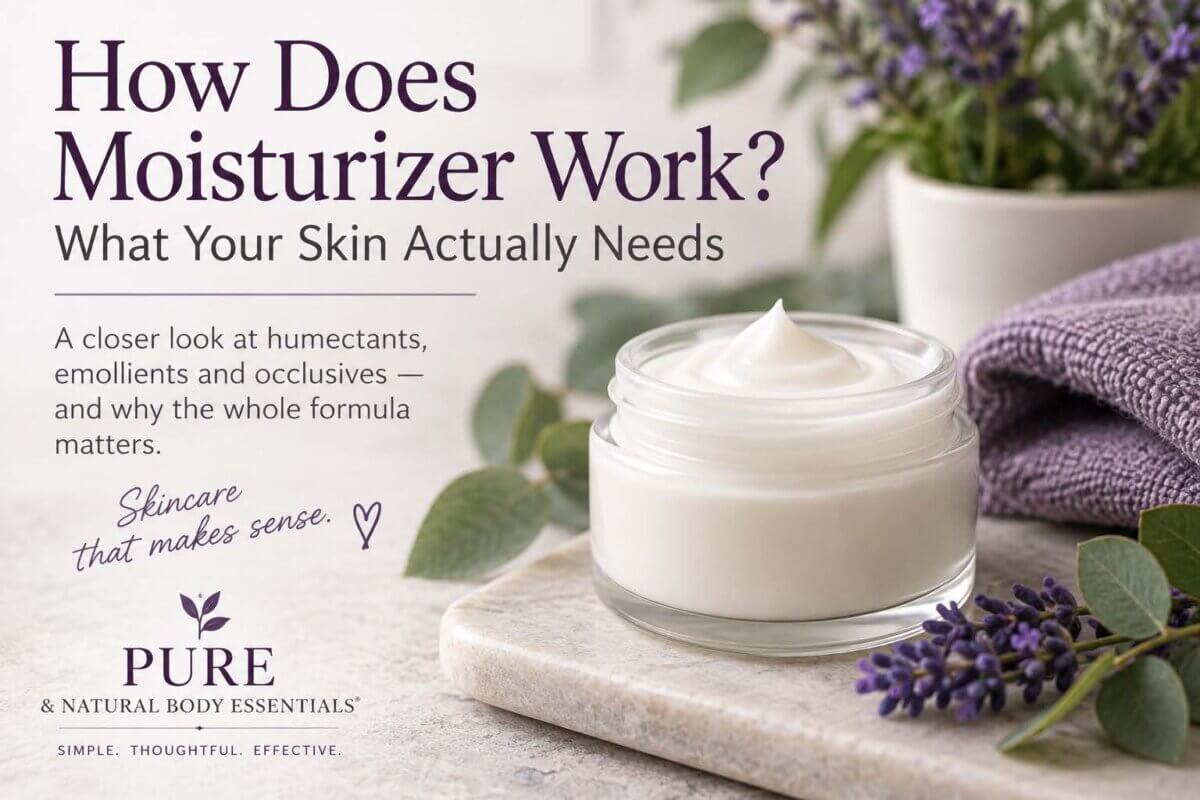
A well-formulated moisturizer usually combines three things: humectants, emollients and occlusives. One helps with hydration, one helps soften and smooth the skin, and one helps keep that moisture from escaping too quickly.
That’s very different from choosing a product simply because one ingredient happens to be popular right now.
How Does Moisturizer Work on Your Skin?
Your skin needs both water and lipids to stay comfortable and maintain a healthy skin barrier.
That’s why I don’t think of moisturizing as simply putting oil on dry skin.
A balanced moisturizer can help bring hydration to the skin, soften and smooth it, and help reduce moisture loss.
That’s where humectants, emollients and occlusives come in.
They don’t all do the same thing—and that’s the point.
Humectants Help With Hydration
Humectants help attract and hold water.
Ingredients such as glycerin, panthenol and hyaluronic acid are examples of humectants you may see in skincare.
I think this is one of the most misunderstood parts of moisturizing.
If your skin feels dry, your first instinct might be to reach for something heavier or oilier. But skin can need water, too.
Putting more oil on your skin doesn’t necessarily provide that hydration.
That’s why humectants have an important job in a moisturizer: they help the skin hold onto water instead of relying only on oils and fats to make the surface feel softer.
Emollients Help Skin Feel Soft and Smooth
Then we have emollients.
These help soften and smooth the skin, especially when it feels rough, flaky or tight.
Plant oils such as jojoba and rosehip can act as emollients, along with other ingredients used specifically to improve the feel and flexibility of the skin.
This is often the part you notice right away.
Your skin feels softer. It doesn’t feel as rough. It feels more comfortable.
But soft skin and hydrated skin aren’t necessarily the same thing.
That’s why I don’t want an emollient doing all the work by itself.
Occlusives Help Keep Moisture From Escaping
The third piece is occlusion.
Occlusive ingredients help slow down the amount of water that escapes from your skin.
Think about it this way: there’s not much point in helping your skin hold water if that water disappears again too quickly.
Oils, butters, waxes and other ingredients can provide different amounts of occlusion depending on the formula.
This can be particularly helpful for dry skin and skin that struggles to hold onto moisture.
But again, that’s one job.
And this is where I think some of the conversation around oils and heavier fats gets a little oversimplified.
So how does moisturizer work when your skin is already dry or dehydrated? It comes back to that balance between adding hydration, softening the skin and helping slow moisture loss.
What About Oils, Butters and Tallow?
Yep. I’m going to say it. Tallow. 😂
Tallow is having quite the moment in skincare.
And this isn’t about saying tallow is terrible or that nobody should use it. Tallow, plant oils, butters and other fats can soften the skin and help reduce moisture loss.
They have a job.
But that’s the point: they have a job. They aren’t the whole formula.
An oil- or fat-based product without water is an anhydrous product. It doesn’t provide the same combination of water, humectants, emollients and occlusives that can be built into a well-formulated lotion or cream.
If someone loves putting tallow on their skin and their skin loves it, great.
It’s just not how I choose to formulate a facial moisturizer for Pure.
I want more from a moisturizer than something that primarily softens the skin and helps slow water loss.
I want hydration in there, too.
Why Can Skin Still Feel Dry Under Something Greasy?
This is something that drives people crazy.
You put on a rich product. Your face feels oily. But somehow your skin still feels dry or tight underneath it.
How can your skin be greasy and dry at the same time?
Because grease isn’t the same thing as hydration.
A heavier oil or fat can coat and soften the skin and help slow down water loss. But if there isn’t enough hydration there in the first place, adding more oil isn’t necessarily going to solve that problem.
The opposite is true, too.
Water alone isn’t a moisturizer. Put water on your skin and eventually it evaporates.
That’s why I keep coming back to balance.
Why a Balanced Moisturizer Can Feel Better
This is where the three-part team comes together.
Humectants help attract and hold water.
Emollients help soften and smooth.
Occlusives help slow moisture loss.
When they’re balanced properly, you can get hydration and softness without necessarily feeling like you’ve coated your face in something heavy and greasy.
For sensitive and reactive skin, I think that matters even more.
If your skin already reacts easily, feels tight or becomes uncomfortable, throwing more and more products at it isn’t necessarily better.
Sometimes it just needs a simple formula where the ingredients make sense together.
Heavier Doesn’t Automatically Mean Better
This is another skincare idea I wish we’d get away from.
A moisturizer doesn’t have to be incredibly thick or greasy to be effective.
And a lightweight moisturizer isn’t automatically less moisturizing.
It comes down to the formula.
What ingredients are providing hydration?
What is softening the skin?
What’s helping reduce moisture loss?
How do those ingredients work together?
That’s much more useful to me than judging a moisturizer by how thick it is.
The Problem With Chasing One Trendy Ingredient
This is probably the biggest reason I wanted to write this.
Skincare marketing loves a star ingredient.
There’s always something we’re suddenly supposed to believe our skin can’t live without.
And I just don’t formulate that way.
I’m not interested in putting something in a Pure product simply because everyone is talking about it.
I want to know:
What is it doing?
Why is it there?
Does the formula actually need it?
How does it work with everything else?
Because an impressive ingredient on the front of a label doesn’t tell you whether the entire formula is any good.
And when you’re dealing with sensitive or reactive skin, I think that distinction becomes even more important.
How I Formulate Moisturizers at Pure
When I’m working on a formula for Pure & Natural Body Essentials®, I start with what I want that product to actually do.
For a facial moisturizer, I want hydration. I want the skin to feel soft and comfortable. I want to support the skin barrier and help the skin hold onto that moisture.
And I don’t want you feeling like you’ve smeared something heavy all over your face just because somebody decided heavier must mean better.
That’s the thinking behind products like my Resilience Balance Facial Lotion.
It’s a lightweight moisturizer made with ingredients that have different purposes within the formula, including aloe, green tea, panthenol, jojoba and rosehip.
No single one of those ingredients is the magic ingredient.
It’s what the formula does as a whole that matters.
And that’s really my philosophy with Pure.
Every ingredient should have a purpose.
Every product should have a reason to exist.
What Should You Look for in a Moisturizer?
Don’t get too caught up in finding whatever ingredient is trending this month.
Instead, pay attention to what your moisturizer actually does for your skin.
Does your skin feel hydrated after you use it?
Does it feel softer and more comfortable?
Does the moisturizer absorb nicely, or does it leave you feeling coated?
A moisturizer that works for someone else’s skin isn’t automatically going to be right for yours—especially if your skin is sensitive or reactive.
And if you’re trying something new, introduce it slowly and pay attention to how your skin responds.
So, How Does Moisturizer Work?
A well-formulated moisturizer doesn’t rely on one ingredient to do everything.
Humectants help with hydration. Emollients help soften and smooth the skin. Occlusives help slow moisture loss.
Oils, butters and heavier fats—including tallow—can absolutely play a role in skincare. But they’re one part of a much bigger formulation picture.
That’s why I’m not interested in chasing the ingredient of the moment.
Your skin doesn’t need one trendy ingredient.
It needs a formula that makes sense. 💜
— Diane
Pure & Natural Body Essentials®