
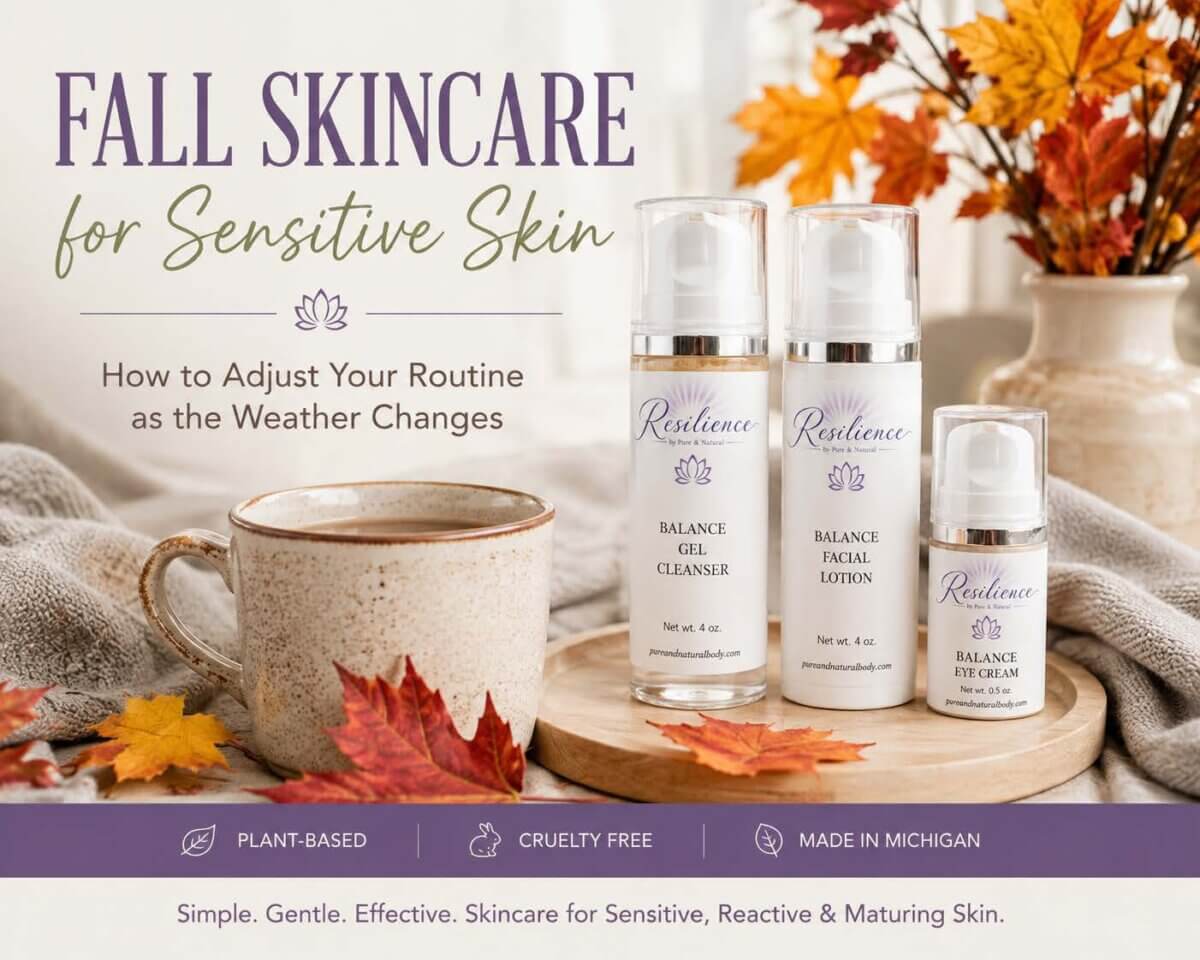
Fall Skincare for Sensitive Skin: How to Adjust Your Routine
When summer begins to fade into cooler weather, your skin may notice the change before you do.
A fall skincare for sensitive skin routine doesn’t have to mean replacing everything in your bathroom cabinet. In fact, if your skin is sensitive, reactive, or maturing, making several changes at once may be the last thing it needs.
As temperatures drop and humidity changes, skin can begin feeling tighter, drier, rougher, or simply different. Indoor heating later in the season can add another change to your skin’s environment.
The American Academy of Dermatology notes that cold, dry outdoor air combined with dry indoor heat can contribute to dry skin, and dermatologists recommend adjusting moisturizing routines when seasonal conditions change.
The goal isn’t to start over every September.
It’s to notice what your skin is telling you and make small adjustments when they’re actually needed.
Why Does Sensitive Skin Change in the Fall?
Skin loses water to its surrounding environment. When humidity drops, it can become more difficult for skin to hold onto moisture.
Add wind, cooler temperatures, indoor heating, hot showers, and normal changes that happen as skin matures, and a routine that felt perfect during a humid Michigan summer may suddenly feel different.
You might notice:
- Tightness after cleansing
- Dry or rough-feeling areas
- Flaking
- Lips becoming dry more quickly
- Skin feeling less comfortable after being outside
- A moisturizer that doesn’t seem to last as long
- Increased sensitivity to products you normally tolerate
That doesn’t automatically mean your skincare products have stopped working.
Sometimes the environment changed — not your skin products.
What Is the Best Fall Skincare for Sensitive Skin?
The best fall skincare for sensitive skin is usually simple: gentle cleansing, enough moisture to keep your skin comfortable, daily sun protection, and fewer unnecessary changes.
You don’t automatically need a completely different fall routine.
Start by asking:
Does my skin still feel comfortable with what I’m already using?
If the answer is yes, there may be nothing to change yet.
If the answer is no, change one thing at a time so you can tell how your skin responds.
1. Pay Attention to How Your Skin Feels After Cleansing
Your face should feel clean after washing.
It shouldn’t have to feel squeaky, tight, or stripped to be clean.
If your skin begins feeling tighter after cleansing as fall arrives, look at your entire cleansing routine before replacing your cleanser.
Ask yourself:
- Is the water too hot?
- Am I washing more often than necessary?
- Am I rubbing my skin with a washcloth?
- Am I using a cleansing brush?
- Am I double cleansing every night whether I need to or not?
- Have I recently added another exfoliating or active product?
Dermatologists recommend gentle cleansing for dry and sensitive skin, and AAD guidance also recommends warm rather than hot water when dryness is a problem.
The Resilience Balance Gel Cleanser is a low-foam cleanser created for sensitive and reactive skin. It removes everyday buildup, makeup, sunscreen, and excess oil without being designed to leave skin with that stripped, squeaky-clean feeling.
Does Cleanser pH Matter More in the Fall?
A cleanser’s pH is only one part of how gentle a cleanser feels, but it can matter for sensitive skin.
If you’ve wondered what pH has to do with cleansing, read our guide to cleanser pH for sensitive skin.
A good fall routine isn’t about finding the strongest cleanser. It’s about cleansing effectively without unnecessarily stressing skin that may already be adjusting to changing weather.
2. Adjust Moisture Before Replacing Your Moisturizer
This is where fall skincare advice can get unnecessarily complicated.
September arrives and suddenly everyone is told to replace a lightweight moisturizer with the thickest cream they can find.
That’s not necessary for everyone.
When planning fall skincare for sensitive skin, pay attention to how your moisturizer actually performs rather than assuming you automatically need something heavier.
If your current moisturizer keeps your skin comfortable, keep using it.
If your skin starts feeling drier, first try:
- Applying moisturizer consistently
- Applying it while skin is still slightly damp
- Using a little more when needed
- Paying attention to areas that become dry first
AAD guidance recommends applying moisturizer to damp skin because it helps trap existing water in the skin.
Some people will eventually need a richer moisturizer as the weather gets colder. Others prefer and do well with lightweight moisture throughout the year.
There isn’t one correct texture for everyone.
The Resilience Balance Facial Lotion was created for sensitive, reactive, and maturing skin that needs daily hydration without an unnecessarily heavy feel.
3. Don’t Confuse Rough Skin With Skin That Needs Scrubbing
This one is important.
When skin begins feeling rough or flaky, it’s tempting to exfoliate it away.
More exfoliation isn’t automatically the answer.
If your skin already feels dry, tight, irritated, or unusually sensitive, aggressive exfoliation may make it feel worse.
AAD dermatologists specifically caution against exfoliating dry, peeling skin during colder conditions because it can further strip moisture.
Before reaching for another scrub, peel, acid, or exfoliating treatment, look at the basics:
How are you cleansing? Are you moisturizing consistently? Has the weather changed? Did you recently introduce another product?
Sometimes rough-feeling skin needs a gentler routine rather than another treatment.
4. Don’t Change Five Products at Once
New season. New clothes. New candles. New routine.
Fall makes starting over feel good.
Your sensitive skin may disagree.
Introducing a cleanser, serum, exfoliant, moisturizer, and treatment at the same time creates another problem: if your skin reacts, which product caused it?
You may have no idea.
Introduce new skincare products individually and give your skin time to respond.
If you have reactive skin, you can also patch test a new skincare product before using it more broadly.
This is especially useful when you’re already experiencing seasonal changes because it removes another variable from the equation.
5. Keep Your Fall Skincare Routine Simple
Sensitive skin doesn’t earn bonus points for having ten steps.
Your routine can be surprisingly straightforward.
Morning
- Cleanse gently if your skin needs it.
- Apply moisturizer.
- Apply broad-spectrum sunscreen.
Evening
- Gently remove makeup and sunscreen.
- Cleanse.
- Apply eye cream or another product you already tolerate, if desired.
- Moisturize.
That’s enough for many people.
If your skin tends to become overwhelmed by complicated routines, our Simple Skincare Routine for Sensitive Skin goes into this approach in more detail.
Consistency often matters more than continually adding another product.
6. Yes, You Still Need Sun Protection in the Fall
The temperature outside doesn’t determine whether ultraviolet radiation exists.
AAD dermatologists recommend year-round sun protection, including broad-spectrum sunscreen with an SPF of 30 or higher on exposed skin.
American Academy of Dermatology: cold-weather sun protection
So don’t pack the sunscreen away with your summer clothes.
What may change is how your sunscreen feels.
If your skin becomes drier in cooler weather, a sunscreen you loved in July may feel different in October. Look at the complete routine rather than immediately assuming one product is responsible.
7. Don’t Forget Your Lips
For some people, the first sign of cooler weather isn’t dry facial skin.
It’s dry lips.
Wind, cooler temperatures, and lower humidity can leave lips feeling uncomfortable. Using lip care consistently before they become extremely dry can be easier than waiting until they’re already cracked and uncomfortable.
Choose something that feels comfortable enough that you’ll actually use it regularly.
If a lip product causes burning, stinging, or irritation, stop using it rather than assuming the sensation means it’s working.
8. Fall Body Care Matters Too
Your face isn’t the only skin exposed to seasonal changes.
Arms, legs, hands, and other areas can start feeling noticeably drier as humidity drops and indoor heating begins.
One of the simplest changes is applying body moisturizer after bathing while your skin is still slightly damp.
AAD dermatologists recommend this approach because moisturizer helps trap existing moisture in the skin. They also recommend keeping showers relatively short and using warm rather than hot water when dealing with dryness.
If you skipped body lotion during humid summer weather because it felt uncomfortable, fall may be a good time to bring it back.
9. Maturing Skin May Notice Fall Earlier
Skin changes throughout life, and its ability to retain moisture can change with age.
AAD notes that skin holds less moisture as we get older, which can make seasonal dryness more noticeable.
That doesn’t mean maturing skin requires an enormous “anti-aging” routine.
A strong foundation is still surprisingly simple:
- Gentle cleansing
- Consistent moisture
- Sun protection
- Products your skin comfortably tolerates
- Avoiding unnecessary irritation
Your skin doesn’t need to look 25.
It needs to feel comfortable and supported at the age you are now.
10. Let Your Skin Decide When Fall Starts
Here in Michigan, September doesn’t always behave like fall.
It can be sweater weather on Monday and feel like July again by Thursday.
Your skincare routine doesn’t need to change because the calendar says September 1.
Let your skin decide.
If your summer routine still feels great, continue it.
If your cheeks begin feeling tight, adjust.
If your body starts feeling dry, moisturize more consistently.
If your lips become dry, start using lip care regularly.
The best fall skincare for sensitive skin responds to your actual skin rather than a seasonal skincare checklist.
Fall skincare for sensitive skin works best when you adjust gradually instead of replacing products that are already working.
Signs Your Fall Routine May Need an Adjustment
Your skin may be telling you something needs to change if you consistently notice:
- Tightness after cleansing
- New dry or flaky areas
- Rough texture
- Moisturizer no longer keeping skin comfortable
- Increased sensitivity
- Dry lips
- Body skin feeling tight after showering
These signs don’t identify one specific cause, but they are useful signals to look at your routine and environment.
If your skin is significantly painful, cracked, bleeding, persistently itchy, or irritated despite changing your routine, consider seeing a board-certified dermatologist. AAD recommends medical evaluation when significant dryness doesn’t improve with self-care.
Fall Skincare for Sensitive Skin Is About Adjusting, Not Starting Over
Your skin doesn’t need a completely new identity every season.
As summer turns to fall, pay attention to what changes and what doesn’t.
Keep cleansing gentle.
Moisturize according to how your skin feels.
Don’t over-exfoliate rough or dry skin.
Continue sun protection.
Introduce new products one at a time.
And most importantly, don’t replace something your skin loves simply because the season changed.
The best routine isn’t necessarily the newest or longest one.
It’s the one your skin is comfortable using consistently.
One of the most important parts of fall skincare for sensitive skin is paying attention to comfort rather than following a seasonal trend.
Frequently Asked Questions About Fall Skincare for Sensitive Skin
When should I change my skincare routine for fall?
There isn’t a specific date. Adjust your routine when you notice changes such as increased dryness, tightness, roughness, or your usual moisturizer no longer keeping your skin comfortable.
Should I use a heavier moisturizer in the fall?
Not automatically. Some people benefit from a richer product as humidity drops, while others remain comfortable with a lightweight moisturizer throughout fall. Let your skin’s needs guide the decision.
Why does my sensitive skin feel drier in fall?
Lower humidity, cooler weather, wind, and eventually indoor heating can contribute to moisture loss and dryness.
Should I exfoliate flaky skin in the fall?
Be careful. If skin is already dry or sensitive, increased exfoliation may cause additional irritation. Start by evaluating your cleansing and moisturizing routine rather than automatically adding more exfoliation.
Should I wash my face twice a day in cooler weather?
Not everyone needs to. How often you cleanse depends on your skin, products, makeup, sunscreen, and daily activities. AAD notes that for some people with dry or sensitive skin, cleansing once daily in the evening may be sufficient.
Do I need sunscreen during fall?
Yes. Sun protection is recommended year-round, not just during warm weather.
Should I replace my summer skincare products when fall arrives?
Not if they’re still working well. Keep products your skin tolerates and make individual adjustments when your skin actually needs them.