If you have sensitive or reactive skin, you probably pay attention to ingredients when choosing skincare. But another factor matters too: pH. Understanding cleanser pH for sensitive skin can help explain why some products leave your face comfortable while others leave it feeling tight or dry.
The pH of a skincare product can affect how it interacts with your skin. This is especially important when choosing a gentle cleanser for sensitive skin, because healthy skin is naturally slightly acidic — not neutral.
But what does that actually mean? Should your facial cleanser be pH 5? What about body wash? Shampoo? Conditioner? And is a product automatically gentle just because it has the “right” pH?
Let’s make pH a lot less complicated.
What Is pH?
pH is a measurement used to describe how acidic or alkaline something is.
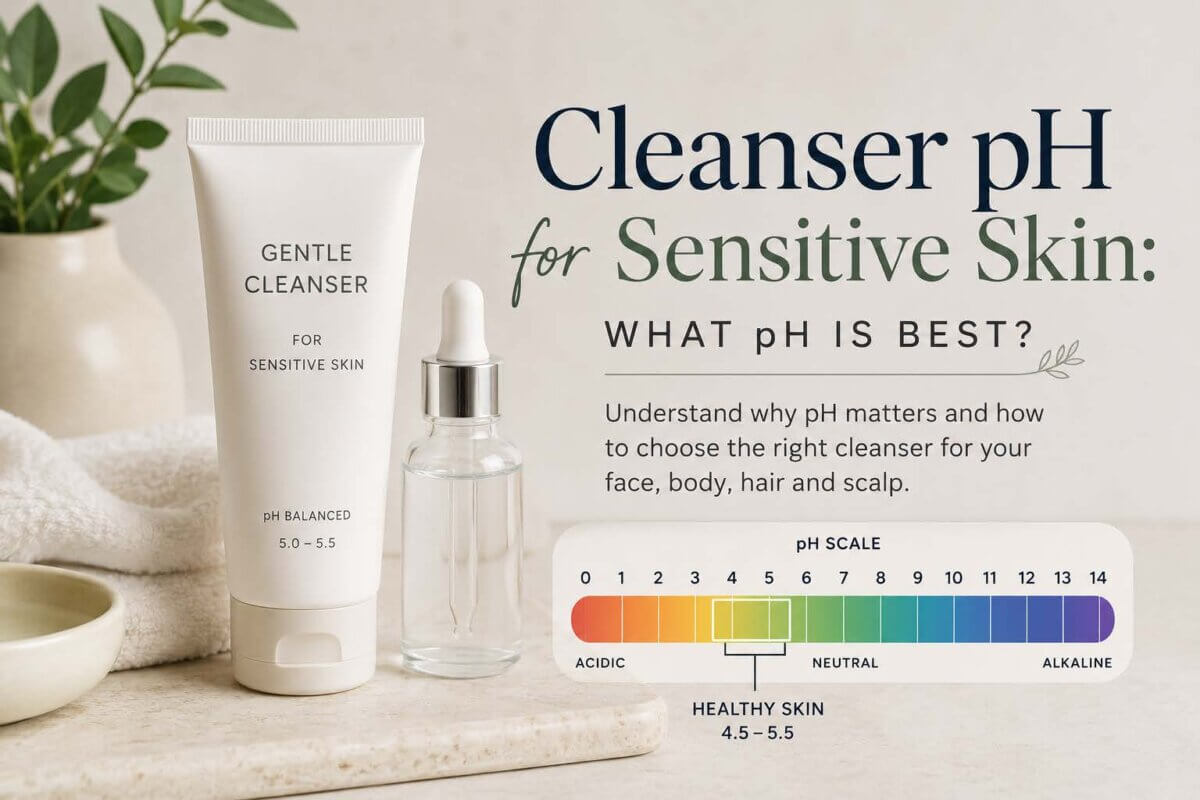
The scale runs from 0 to 14:
- A pH below 7 is acidic.
- A pH of 7 is neutral.
- A pH above 7 is alkaline.
You encounter different pH levels every day, even if you never think about them.
Here are some familiar examples:
| Substance | Approximate pH |
|---|---|
| Lemon juice | 2–3 |
| Vinegar | 2–3 |
| Healthy skin surface | About 4.5–5.5 |
| Pure water | 7 |
| Baking soda solution | About 8–9 |
| Traditional soap | About 9–10 |
These are approximate ranges. The actual pH can vary depending on the specific product, formulation, concentration, and other factors.
The important thing to notice is that healthy skin isn’t actually neutral.
What Is the Natural pH of Your Skin?
The surface of healthy skin is naturally mildly acidic.
You may have heard this described as the skin’s acid mantle. This slightly acidic environment is associated with normal skin-barrier function and the environment in which the skin’s microorganisms live.
Research has found that natural skin-surface pH is generally below 5.5, although the exact number varies between people and between different areas of the body.
Age, sweat, sebum, moisture, environment, skincare products, and even where you measure the skin can influence the result.
That means there isn’t one magical pH number that every person’s skin must maintain.
But it does help explain why repeatedly washing mildly acidic skin with highly alkaline products may not be ideal — particularly when your skin is already dry, sensitive, or reactive.
Why Does Cleanser pH Matter for Sensitive Skin?
Every time you wash your face, you’re trying to remove things you don’t want sitting on your skin:
- Makeup
- Sunscreen
- Excess oil
- Sweat
- Dirt
- Environmental buildup
A cleanser needs to remove those things effectively.
The goal, however, isn’t to remove everything from the surface of your skin.
Research has shown that highly alkaline cleansing can affect proteins and lipids in the outermost layer of the skin. That’s one reason traditional alkaline soaps may leave some people’s skin feeling tight or dry after washing.
For someone whose skin already reacts easily, choosing a gentle cleanser for sensitive skin with a skin-compatible pH can be one part of reducing unnecessary stress during cleansing.
But pH isn’t the whole story.
We’ll come back to that.
What Is the Best Cleanser pH for Sensitive Skin?
F
For facial skin, particularly sensitive or reactive skin, a mildly acidic cleanser around pH 5 to 5.5 is generally a reasonable target.
That puts the cleanser closer to the naturally acidic environment of healthy skin.
It does not mean a cleanser at pH 5.6 is suddenly bad for your face, nor does it mean everyone needs to test every bottle in the bathroom.
Think of pH as one characteristic of a well-formulated cleanser rather than a pass-or-fail number.
When choosing a cleanser for sensitive skin, the bigger question is:
How does your skin feel after you use it?
Your face should feel clean and comfortable — not squeaky, painfully tight, burning, itchy, or excessively dry.
Does pH 7 Mean a Product Is Gentler?
This is a common misconception because we tend to associate the word neutral with something being mild.
But neutral doesn’t automatically mean better for skin.
Pure water has a pH around 7, but your skin’s surface is naturally more acidic than that.
Likewise, an acidic product isn’t automatically harsh simply because its pH is below 7.
That’s why “pH balanced” can be useful information on a product, but you need context. Balanced to what?
For facial skincare, mildly acidic products are generally more compatible with the skin’s natural surface environment than highly alkaline products.
Does the Right pH Automatically Make a Cleanser Gentle?
No — and this is important.
A cleanser can have a perfectly appropriate pH and still be uncomfortable for your skin.
Why?
Because pH is only one part of the formula.
You also need to consider:
- The type and concentration of cleansing agents
- Fragrance
- Essential oils
- Exfoliating ingredients
- Other active ingredients
- How frequently you cleanse
- Water temperature
- How much friction you use
- Your individual sensitivities
A pH of 5.5 cannot compensate for a formula that is simply too aggressive for your particular skin.
That’s why I would never choose a gentle cleanser for sensitive skin based on pH alone.
What pH Should Body Wash Be?
The skin on your body also has a naturally acidic surface, although pH can vary considerably depending on the area.
Your underarms, hands, feet, back, and other areas don’t necessarily have identical conditions.
Sweat, oil production, moisture, friction, and even clothing can affect the environment of different areas of the body.
For everyday cleansing, a mildly acidic, skin-compatible body cleanser can be a good choice, particularly if your skin tends to feel dry or uncomfortable after showering.
This is also one reason some people notice such a dramatic difference when switching from traditional alkaline soap to a milder body cleanser.
Again, there isn’t one exact pH number that every body wash needs to hit.
What matters is effective cleansing without unnecessarily stripping the skin.
What pH Should Shampoo Be?
Now things get even more interesting because your scalp is skin — but your hair shaft isn’t.
The scalp has its own naturally acidic environment. Hair fibers also respond to pH.
Highly alkaline products can increase swelling of the hair fiber and affect the cuticle. Research into shampoo pH has suggested that lower-pH shampoos may help reduce friction between hair fibers compared with more alkaline products.
Many shampoos are therefore formulated on the acidic side rather than at a highly alkaline pH.
That doesn’t mean the lowest possible pH makes the best shampoo. Hair type, scalp condition, cleansing agents, conditioning ingredients, and the entire formulation still matter.
Just like facial skincare, pH is one piece of the formulation puzzle.
What About Conditioner?
Conditioners are commonly formulated on the acidic side as well.
After cleansing, conditioning products are intended to improve properties such as softness, smoothness, manageability, and reduced friction.
An acidic environment can help the hair cuticle lie flatter compared with exposure to highly alkaline conditions.
That’s one reason shampoo, conditioner, facial cleanser, and body wash shouldn’t simply be formulated to exactly the same pH.
They are being used on different materials and for different purposes.
Why Can Traditional Soap Feel Different?
Traditional soap is typically alkaline, often somewhere around pH 9–10.
That doesn’t make soap inherently “bad.” It means it has very different chemistry from mildly acidic facial cleansers.
Some people tolerate traditional soap perfectly well on certain areas of their bodies.
Others — particularly those with dry, sensitive, or reactive facial skin — may notice that it leaves their skin feeling tight or uncomfortable.
Modern cleansing bars can also be formulated differently from traditional soap, so simply seeing a product in bar form doesn’t tell you its pH or how gentle it will be.
The best clue is still how your skin responds.
How Should Your Face Feel After Cleansing?
Forget the idea that your face needs to feel squeaky clean.
That isn’t the goal.
After using a gentle cleanser for sensitive skin, your face should simply feel clean and comfortable.
Pay attention if your skin consistently feels:
- Tight
- Very dry
- Itchy
- Rough
- Burning
- Uncomfortably stretched
Those sensations don’t automatically mean the cleanser’s pH is wrong. They can also result from over-cleansing, hot water, friction, strong cleansing agents, or an ingredient your skin doesn’t tolerate.
But they’re worth paying attention to.
Your skin gives you information.
Your Cleansing Technique Matters Too
You can buy a beautifully formulated cleanser and still irritate your skin by using it too aggressively.
For sensitive or reactive skin, keep cleansing simple.
Use lukewarm water rather than very hot water.
Apply your cleanser using your fingertips rather than aggressively rubbing your face with a washcloth, brush, or cleansing tool.
Massage gently. You don’t need to scrub.
Rinse thoroughly and pat your skin dry rather than rubbing it with a towel.
The American Academy of Dermatology also recommends using a gentle, non-abrasive cleanser and avoiding scrubbing when washing the face.
If you wear makeup, removing it gently matters too. You can read our guide to removing makeup when you have sensitive skin for more tips.
Do You Need to Test the pH of Your Skincare at Home?
Probably not.
Yes, you can buy pH strips and start testing everything in your bathroom.
But most people don’t need to turn skincare into a chemistry experiment.
If a manufacturer provides the finished product’s pH, that’s useful information.
More importantly, look at the complete formula and pay attention to your skin.
A well-formulated cleanser that leaves your skin comfortable is more important than obsessing over whether something measures exactly 5.2 or 5.4.
How to Choose a Gentle Cleanser for Sensitive Skin
When shopping for a gentle cleanser for sensitive skin, don’t rely on a single claim on the front of the bottle.
Look for a cleanser that:
- Effectively removes normal daily buildup
- Doesn’t require aggressive scrubbing
- Rinses away easily
- Doesn’t consistently leave your skin tight or stripped
- Fits comfortably into your daily routine
- Avoids ingredients you already know cause problems for your skin
- Has a skin-compatible formulation
If your skin reacts easily, introduce new skincare products one at a time rather than changing your entire routine at once.
You can also read our guide on how to patch test skincare for sensitive skin before introducing something new.
A Simple Routine for Sensitive and Reactive Skin
You don’t need six cleansing steps.
A basic routine can be:
Step 1: Wet your face with lukewarm water.
Step 2: Apply a small amount of gentle cleanser with your fingertips.
Step 3: Massage lightly without scrubbing.
Step 4: Rinse thoroughly.
Step 5: Pat your face dry.
Step 6: Follow with a moisturizer to help keep your skin comfortable.
Pure & Natural Body Essentials® Resilience Balance Gel Cleanser is a low-foam gentle cleanser for sensitive skin designed to remove everyday buildup without leaving skin feeling excessively stripped.
Follow cleansing with Resilience Balance Facial Lotion for lightweight moisture and barrier support.
If you’re looking for an uncomplicated routine rather than choosing individual products, you can also explore the Resilience Calm Skin Routine™.
Frequently Asked Questions About Cleanser pH
What pH should a gentle cleanser for sensitive skin be?
A mildly acidic cleanser around pH 5 to 5.5 is generally a reasonable target for sensitive facial skin because it is closer to the naturally acidic environment of healthy skin.
However, pH isn’t the only factor that determines whether a cleanser is gentle.
Is pH 7 good for your face?
A pH of 7 is neutral, but healthy skin isn’t actually neutral — its surface is naturally mildly acidic.
That doesn’t mean a product at pH 7 will automatically harm your skin. It simply means that “neutral” and “skin-compatible” aren’t necessarily the same thing.
Is a low-pH cleanser better for sensitive skin?
A mildly acidic cleanser can be a good choice for sensitive skin, but a lower number doesn’t automatically mean a better cleanser.
The complete formulation matters.
Is traditional soap too alkaline for your face?
Traditional soap is generally more alkaline than the skin’s natural surface.
Some people tolerate it without difficulty, while others — particularly those with dry or reactive skin — may find it leaves their face feeling tight or uncomfortable.
What pH should body wash be?
A mildly acidic, skin-compatible body cleanser can be a good choice, particularly for dry or sensitive skin. There isn’t one exact number that every body cleanser needs to have.
What pH should shampoo be?
Shampoos are commonly formulated on the acidic side rather than being highly alkaline. Hair and scalp needs vary, however, so pH alone doesn’t determine whether a shampoo is appropriate for you.
Does pH-balanced mean a product is gentle?
Not necessarily.
“pH-balanced” describes one characteristic of a product. The cleansing agents, fragrance, active ingredients, concentration, and overall formulation still determine how that product interacts with your skin.
The Bottom Line
Understanding pH doesn’t mean you need to test every skincare product you own.
The most important takeaway is simple:
Your skin is naturally mildly acidic, not neutral.
For sensitive and reactive facial skin, a mildly acidic gentle cleanser for sensitive skin can be a good choice. But pH is only one piece of the equation.
A cleanser also needs an appropriate overall formulation, and the way you use it matters.
Choose gentle products, avoid unnecessary scrubbing, use lukewarm water, and pay attention to how your skin actually feels.
Because the best cleanser isn’t the one with the most impressive number on the bottle.
It’s the one that cleans your skin and leaves it comfortable afterward.
References
- Lambers H, et al. Natural skin surface pH is on average below 5, which is beneficial for its resident flora. International Journal of Cosmetic Science.
- American Academy of Dermatology. Face washing 101.
- Dias MFRG, et al. The Shampoo pH Can Affect the Hair: Myth or Reality? International Journal of Trichology.