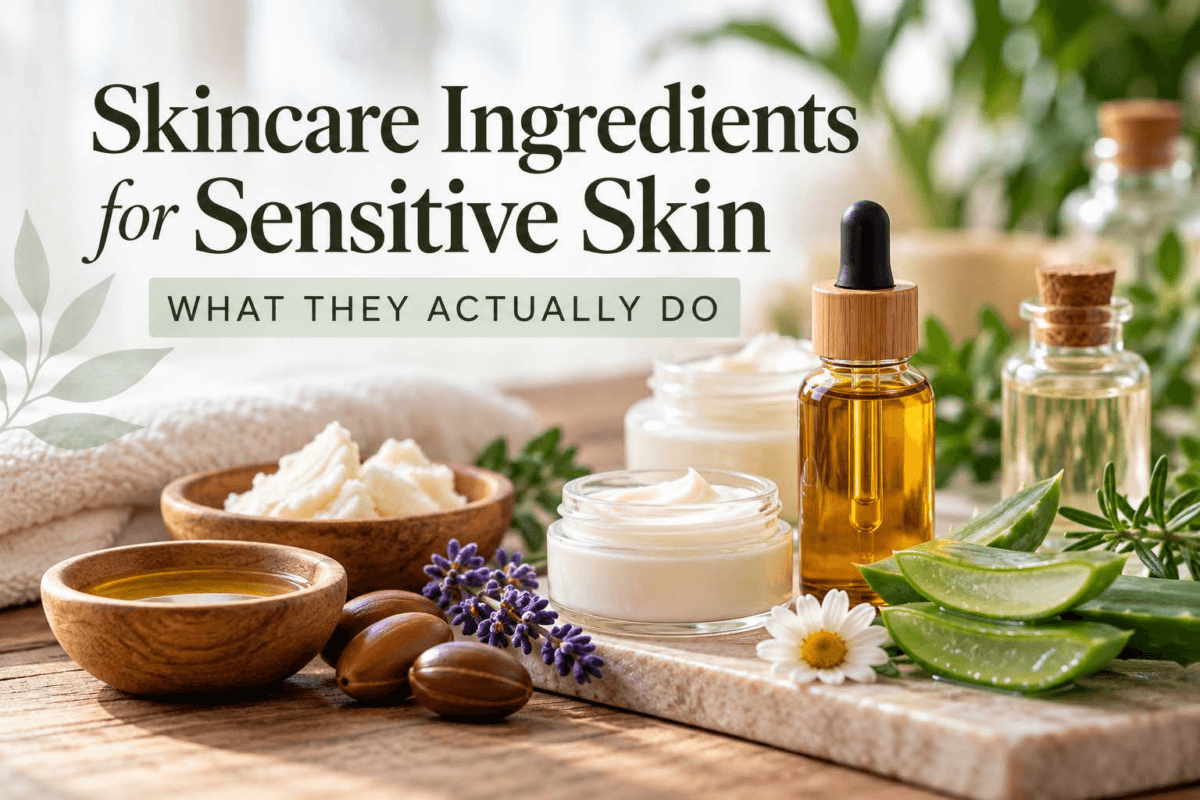
Skincare Ingredients for Sensitive Skin: What They Actually Do
If you have sensitive or reactive skin, reading a skincare ingredient list can feel overwhelming.
Some products contain only a handful of ingredients. Others have ingredient lists that seem to go on forever. It can be tempting to assume that fewer ingredients must mean a gentler product—or that an ingredient with a long, unfamiliar name must be something harsh.
But ingredient lists don’t work that way.
Each ingredient in a properly formulated skincare product has a purpose. Some help attract water to the skin. Others soften it, help reduce moisture loss, create the texture of the product, keep oil and water mixed together, or protect a water-based formula from microbial growth.
Understanding those different jobs can make choosing skincare ingredients for sensitive skin much less confusing.
Instead of judging a product by how long its ingredient list is, it helps to understand why those ingredients are there and what they contribute to the finished formula.
Why Sensitive Skin Makes Ingredient Lists Feel Complicated
When your skin reacts easily, it makes sense to pay attention to what you put on it.
Maybe you’ve tried a product everyone seemed to love, only to end up with redness, itching, tightness, burning, or discomfort. After enough experiences like that, a long ingredient list can start looking like a long list of potential problems.
But the number of ingredients alone doesn’t tell you whether a formula will work well for your skin.
A simple product can contain an ingredient your skin doesn’t tolerate. A longer formula may contain several ingredients working together to create a lightweight, stable product that feels wonderful on your skin.
What matters more is the complete formulation, the purpose of the ingredients, and how your individual skin responds.
If you’re still trying to figure out what your skin needs overall, our Sensitive Skin Care – A Complete Guide explains how to approach sensitive and reactive skin without overcomplicating your routine.
Here are some of the ingredient categories you’ll commonly see in skincare and what they actually do.
Humectants: Helping Skin Hold Onto Water
Humectants are ingredients that attract and bind water.
They’re commonly used in skincare designed to provide hydration, especially when skin feels dry, tight, or dehydrated.
Common humectants include:
- Glycerin
- Hyaluronic acid
- Panthenol
- Aloe vera
- Certain sugars and plant-derived compounds
You’ll find humectants in everything from toners and serums to cleansers and moisturizers.
But hydration isn’t only about attracting water.
Once water is present, other ingredients can help soften the skin and reduce how quickly moisture is lost. That’s where emollients and occlusives become important.
If you’d like a deeper explanation of how these different types of ingredients work together in a moisturizer, read How Does Moisturizer Work? What Your Skin Actually Needs.
Emollients: Making Skin Feel Softer and Smoother
Emollients help soften and smooth the skin’s surface.
Plant oils, butters and other skin-conditioning ingredients can all act as emollients.
Examples include:
- Jojoba oil
- Squalane
- Shea butter
- Mango butter
- Argan oil
- Avocado oil
- Apricot kernel oil
Different emollients can feel completely different on the skin.
Some are extremely lightweight, while others create a richer, more protective feel. Formulators can combine different emollients to achieve a particular texture and level of richness.
That’s one reason seeing oil or butter on an ingredient list doesn’t automatically mean the finished product will feel greasy or heavy.
The entire formulation matters.
Occlusives: Helping Reduce Moisture Loss
Occlusive ingredients help form a protective layer over the skin that slows water loss.
This can be especially useful when skin is dry or when the skin barrier isn’t doing a great job of retaining moisture.
But heavier isn’t automatically better.
Some people with sensitive or reactive skin love rich balms and creams. Others find that lighter lotions are much more comfortable.
A well-formulated moisturizer can combine humectants, emollients and occlusive ingredients to provide hydration and moisture retention without necessarily feeling thick or greasy.
The best texture is the one that gives your skin what it needs and that you’ll actually enjoy using consistently.
Plant Oils: They’re Not All the Same
It’s easy to put every botanical oil into one category, but plant oils can vary considerably.
Different oils have different fatty-acid profiles, textures and skin feels.
Jojoba, for example, is technically a liquid wax and is known for its lightweight feel. Squalane is another lightweight emollient commonly used to provide softness without a particularly heavy or greasy finish.
Other botanical oils can bring different characteristics to a formula.
That’s also why seeing several oils in one product doesn’t necessarily mean the formulator is simply adding more ingredients for the sake of it.
Combining oils can help create a particular consistency, application and overall skin feel.
At the same time, more isn’t automatically better. A thoughtfully formulated combination of ingredients is more important than packing a product with every botanical oil that’s currently trending.
And if you’re wondering whether an oil or serum actually belongs in your routine, Does Sensitive Skin Need a Serum or Facial Oil? explains when adding one may make sense—and when your routine may already be enough.
Thickeners and Gelling Agents Aren’t Just “Fillers”
Some ingredients sound strange simply because most of us don’t encounter their names outside cosmetic formulation.
Thickeners and gelling agents are good examples.
These ingredients may help:
- Create a lotion or gel texture
- Improve how a product spreads
- Keep the consistency uniform
- Help other ingredients remain evenly distributed
- Prevent a formula from becoming too thin
Sclerotium gum, for example, is a gelling and thickening ingredient that can help create a smooth gel texture.
It isn’t there because someone needed to make the ingredient list longer.
It has a job in the formula.
Emulsifiers: Why Your Lotion Doesn’t Separate
Oil and water don’t naturally stay mixed together.
Yet most lotions and creams contain both.
Emulsifiers help bring those ingredients together and keep the finished product stable instead of leaving you with water on the bottom and oil floating on top.
They can also influence how a moisturizer spreads and feels on the skin.
This is another reason lotions and creams often have longer ingredient lists than something simple like a facial oil.
A lotion may need water, oils, humectants, an emulsifying system, thickeners, stabilizers and preservatives simply to create the type of product it’s supposed to be.
Those ingredients aren’t necessarily unnecessary extras.
They’re part of building the formula.
Preservatives: An Important Part of Water-Based Skincare
Preservatives sometimes get treated like something that should automatically be avoided, particularly in conversations about natural skincare.
But water-based skincare needs appropriate protection from microbial contamination.
Any formula containing water can potentially provide an environment where bacteria, yeast or mold can grow. A properly selected preservative system helps protect the product throughout its intended shelf life and normal use.
Think about what happens to skincare after you bring it home.
It’s opened and closed repeatedly. Pumps and lids are touched. Products may sit in warm, humid bathrooms. Sometimes wet hands get involved.
Proper preservation matters.
A preservative isn’t automatically a “bad” ingredient.
In water-based skincare, an appropriate preservative system is an important part of creating a safe, stable product.
That’s why “preservative-free” isn’t automatically better.
Fragrance Oils and Essential Oils: Personal Tolerance Matters
Fragrance is one of those skincare subjects that often gets reduced to “good” or “bad.”
Skin isn’t that simple.
Both fragrance oils and essential oils can be used to create an enjoyable sensory experience, and many people use scented skincare and body care without a problem.
For someone with sensitive or reactive skin, the important consideration is personal tolerance.
Some people know that certain fragrances or essential oils don’t agree with their skin. Others tolerate them perfectly well.
Even two people who both describe their skin as sensitive can respond differently to the exact same product.
That’s why it makes more sense to pay attention to your own skin rather than assuming that every scented product needs to be avoided.
At Pure & Natural Body Essentials, we use both fragrance oils and essential oils in products where scent is part of the experience, while also offering unscented options in several products for people who prefer them or know their skin does better without added scent.
If essential oils are something you’re specifically concerned about, When Essential Oils Help and When They Hurt Sensitive Skin takes a closer look at why individual tolerance matters.
If you’re unsure how your skin will respond to a new scented product—or any new skincare product—patch testing skincare before using it regularly can be a helpful way to introduce it gradually.
Your skin gets the final vote.
Botanical Extracts: More Isn’t Always Better
Botanical extracts can serve useful purposes in skincare, but this is another area where marketing can sometimes get carried away.
A product doesn’t necessarily become better simply because the label lists a dozen different plants.
For sensitive or reactive skin, I prefer purposeful formulation over ingredient collecting.
Every ingredient should have a reason for being there.
That might be hydration, texture, emollience, stability, preservation, scent, or another specific function within the formula.
The goal shouldn’t be to create the longest list of impressive-sounding botanicals.
The goal should be to create a product that makes sense as a whole.
What About Those Long Scientific Ingredient Names?
This is where ingredient lists can look much scarier than they actually are.
Cosmetic labels use standardized ingredient names, commonly called INCI names.
That means an ingredient you recognize immediately in everyday language can look completely unfamiliar on the back of a skincare bottle.
For example:
Shea butter may appear as Butyrospermum Parkii (Shea) Butter.
Jojoba oil may appear as Simmondsia Chinensis (Jojoba) Seed Oil.
Avocado oil may appear as Persea Gratissima (Avocado) Oil.
Those names don’t make the ingredients harsher or somehow less natural.
They’re simply standardized names that identify what’s actually in the product.
So don’t judge an ingredient by how difficult it is to pronounce.
Is a Short Ingredient List Better for Sensitive Skin?
Not necessarily.
This is one of the biggest misconceptions about skincare ingredients.
A simple facial oil might contain only a few ingredients because it doesn’t contain water. There’s no water phase that needs to be emulsified with oil, and an anhydrous product has different formulation requirements than a lotion.
A lotion is a completely different type of product.
A properly formulated lotion may contain water, humectants, oils or other emollients, emulsifiers, stabilizers, thickeners and a preservative system before additional skin-conditioning ingredients are even considered.
Naturally, that ingredient list will be longer.
That doesn’t make the lotion inferior.
It simply means the two products are built differently and serve different purposes.
How to Choose Skincare Ingredients for Sensitive Skin
Instead of counting ingredients or trying to find the shortest ingredient list possible, look at the product as a whole.
Ask yourself:
- What is this product supposed to do?
- Does the formula make sense for that purpose?
- Does it contain an ingredient I already know my skin doesn’t tolerate?
- Does the product seem appropriate for how my skin currently feels?
- Am I introducing too many new products at the same time?
If your skin tends to react easily, introducing new products gradually can make it much easier to figure out what works and what doesn’t.
Patch testing is also useful, especially if you’ve had reactions to skincare products in the past.
And don’t feel pressured to use an ingredient simply because it’s suddenly everywhere on social media.
Sensitive Skin Doesn’t Need Every Skincare Trend
Skincare marketing has a way of making us feel like we’re constantly missing something.
One month everyone supposedly needs a particular oil. The next month it’s a new botanical extract, acid, serum or ingredient you’ve never heard of before.
Suddenly the three products that worked perfectly well last month aren’t enough anymore.
Sensitive skin doesn’t need to chase every trend.
It needs a routine that is comfortable, consistent and appropriate for your skin.
Your cleanser should clean your skin without leaving it feeling stripped or uncomfortably tight. If cleansing is where your irritation tends to start, How to Choose a Gentle Cleanser for Sensitive Skin explains what to look for without turning cleanser shopping into another chemistry exam.
Your moisturizer should provide hydration and help reduce moisture loss while feeling comfortable enough to use every day.
A toner, serum or facial oil should have a purpose in your routine—not simply be there because someone told you that everyone needs one.
Sometimes adding another product is useful.
Sometimes the better choice for reactive skin is to stop adding things and give your skin some consistency.
The Ingredient List Is Only Part of the Story
Learning what skincare ingredients actually do can make choosing products much easier, especially when your skin tends to react.
But don’t let an ingredient list become another source of anxiety.
A long ingredient list doesn’t automatically mean harsh.
A short ingredient list doesn’t automatically mean gentle.
A natural ingredient doesn’t automatically mean your particular skin will love it.
A synthetic ingredient isn’t automatically harmful.
Fragrance isn’t automatically a problem for everyone with sensitive skin.
And a scientific-looking name doesn’t mean an ingredient is something you need to fear.
Instead, ask a better question:
What does this ingredient do in this formula, and does this product make sense for my skin?
Once you start looking at skincare that way, ingredient lists become much easier to understand—and a lot less intimidating.
At Pure & Natural Body Essentials, that’s the approach behind our skincare: purposeful ingredients, comfortable formulas and choices designed to help you build a routine that works for your individual skin rather than whatever happens to be trending this week.